
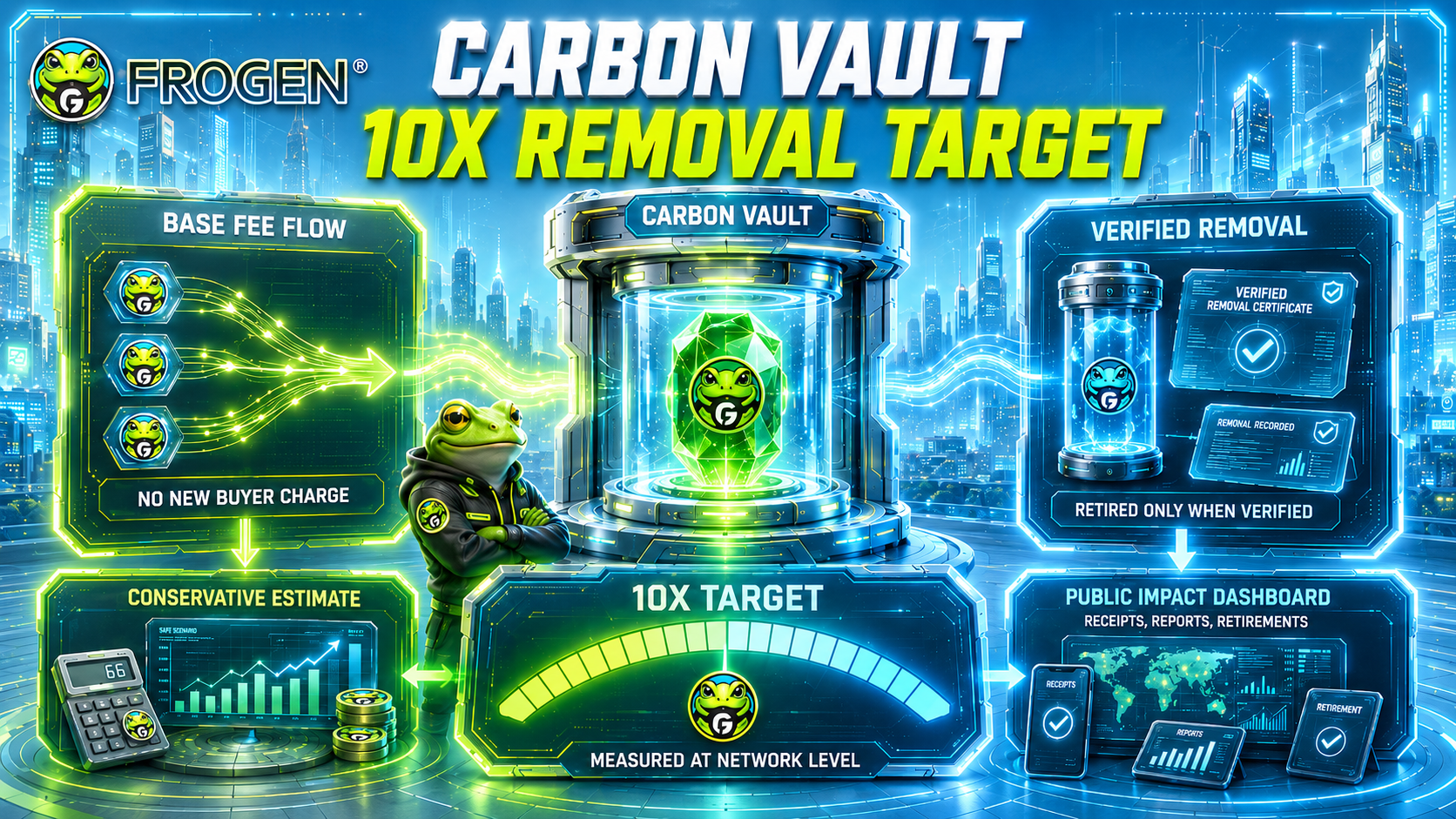
 Short read: The Carbon Reversal Plan is now live in the FROGEN protocol specifications repository. It explains how the FROGEN economy is designed to fund verified carbon removal from existing protocol fee revenue, using a conservative emissions estimate, a 10x removal target, and public reporting through an Impact Dashboard. This is a pre-launch plan, not a completed deployment announcement, and removals are counted only when verified and retired.
Why this plan matters
Most crypto projects either avoid the environmental conversation completely or treat it like a marketing badge. FROGEN is taking a different route.
The Carbon Reversal Plan is not written as a slogan. It is written as a methodology. It explains how the FROGEN economy is designed to estimate its carbon footprint, size a removal target against that footprint, fund that target from protocol revenue, and report the results publicly.
That distinction matters. This is not about claiming that a single transaction magically fixes itself. It is about the FROGEN economy as a whole being designed to fund more verified carbon removal than the network activity is estimated to create. Not vibes, arithmetic.
What is going live today
The Carbon Reversal Plan is now public in the FROGEN protocol specifications repository.
You can read it here:
The document explains the planned Carbon Vault mechanism and the logic behind FROGEN's 10x removal target. In plain terms, the protocol is designed to estimate the carbon footprint of user-initiated FROGEN transfers, then fund verified carbon removal equal to roughly ten times that estimated footprint.
The key phrase is designed to. This is a pre-launch plan: the mechanism is still subject to final implementation, audit review, parameter confirmation at deployment, Carbon Vault activation, and verified partner readiness.
That careful framing is the point. FROGEN is not asking the community to accept a green claim on faith; it is publishing the plan before launch so the assumptions, numbers, funding path, and reporting logic can be inspected.
What the plan covers
The document is written for readers who want to understand the environmental mechanism behind FROGEN before it goes live. It is more technical than a short community update, but the purpose is simple: explain the plan clearly enough that people can check the logic.
| Area | What it explains |
|---|---|
| Carbon goal | The economy-wide target to fund roughly ten times the estimated carbon footprint |
| Emissions estimate | A conservative working figure for successful user-initiated FROGEN transfers |
| Removal price | A blended reference price for verified carbon removal |
| Funding source | Existing ecosystem base-fee revenue, not a new carbon charge |
| Carbon Vault | The planned component that turns pooled revenue into verified removal |
| Reporting | Public dashboard, weekly snapshots, monthly reports, and retirement documentation |
| Guardrails | Pool sufficiency, bounded draws, oversight, and reproducible methodology |
| Risk controls | Greenwashing risk, funding-source risk, partner risk, and reporting limits |
The plan also makes one important boundary clear: carbon reversal is measured and funded at the network level, not as a per-transaction promise.
That means FROGEN is not claiming that every individual transaction is separately neutralized by the fee attached to that same transaction. The plan counts the whole economy, sizes the target periodically, and reports verified retired removal as it happens. That is a stronger and more defensible frame.
The mechanism in plain language
The Carbon Reversal Plan answers one question: how can the FROGEN economy fund verified carbon removal in a way that can be checked?
The planned process is straightforward. The protocol counts successful user-initiated FROGEN transfers over a regular period. It applies a published emissions estimate. It multiplies the estimated footprint by the removal target. It converts that target into a funding amount using a published removal price reference. Then the Carbon Vault draws an authorised allocation from accumulated base-fee revenue and sends funds to verified removal partners. After that, the numbers are reported.
The most important part is that removal only counts toward the reversal figure when credits are verified and retired. Promises do not count. Future expectations do not count. Intent does not count.
Only verified retired removal counts.
That is how the plan avoids becoming another empty environmental claim.
No new fee, no buyer charge
One of the strongest parts of the plan is the funding design. Carbon reversal does not add a new user-facing carbon fee; it is designed to be funded from the existing ecosystem base fee rather than a new carbon charge.
Buyers are not the party charged. Under the planned directional transfer rules, recognised AMM-pair buys are intended to be fee-free, while fee-bearing activity such as selling and sending contributes to the broader protocol revenue system. That creates a deliberate asymmetry: the footprint is measured across the whole FROGEN economy, including fee-free and exempt transfers, while the funding comes from fee-bearing activity. In simple terms, the parts of the economy that generate fee revenue help fund verified removal for the whole network.
Buyers are not charged. Holders and stakers remain aligned with the reward system. Fee-bearing activity helps fund a public-good layer that reflects on the entire pond.
Why the wording matters
Carbon language is easy to overstate, which is why this plan avoids careless framing. It does not lean on vague claims about saving the planet. It does not treat carbon removal as a decorative badge. It does not claim that each transaction is individually neutralized in isolation. Instead, it frames the claim where the math is intended to hold: the FROGEN economy in aggregate.
The plan is designed around verified removal, not avoidance credits. The portfolio is intended to include nature-based removal and reforestation, biochar, and a smaller durable engineered-removal slice that can grow over time.
That matters because not all carbon credits are equal. The plan sets procurement standards around verified removal, independent ratings, multiple partners, public documentation, and retirement evidence. Those standards are what make the mechanism more than a headline.
Why this is being published before deployment
We are publishing this now for the same reason we have been releasing the full specification suite publicly: review is more useful before everything is final.
A finished dashboard is important. A deployed Carbon Vault is important. Verified partner documentation is important. But the plan comes first, because the plan is what lets people inspect the methodology before it becomes a public claim.
Readers should be able to see how the footprint is estimated, how the removal target is sized, where the funding comes from, what the Carbon Vault is meant to do, what is on-chain, what is off-chain, and where the limits are.
That is the correct order: first, publish the intended mechanism; then review it; then implement it; then report the verified results publicly.
The pond does not need louder claims. It needs claims people can check.
Updated publication schedule
The Carbon Reversal Plan is the third release in the specification sequence. The remaining documents will continue to be published separately so each mechanism can be reviewed on its own terms.
| Specification | Target date | Status | What it covers |
|---|---|---|---|
| DynamicStaking Specification | May 30, 2026 | Live | Staking mechanism, APR math, pool health |
| SmartVest Specification | June 7, 2026 | Live | Adaptive fee curve, base fee, pool-health response |
| Carbon Reversal Plan | June 15, 2026 | Live | Carbon Vault mechanism and the 10x removal target |
| GasPool Specification | June 22, 2026 | Upcoming | Sponsored gas through meta-transactions |
| Economic Mechanism Addendum | June 29, 2026 | Upcoming | Shared mathematical foundations across the contracts |
| Cross-Contract Specification | July 5, 2026 | Upcoming | System architecture and contract interactions |
Each document adds another layer of visibility. DynamicStaking explained the reward side. SmartVest explained the fee-calculation side. The Carbon Reversal Plan now explains how a share of ecosystem fee revenue is intended to support verified removal.
The system is becoming easier to inspect, one document at a time.
What this does and does not mean
We want to keep the meaning of this release precise.
What it means. The Carbon Reversal Plan is now described publicly in the FROGEN protocol specifications repository. Anyone can review the intended methodology, the conservative emissions estimate, the 10x removal target, the planned Carbon Vault flow, the funding source, the reporting model, and the risk controls around the mechanism.
What it does not mean. This is not a completed deployment announcement. It is not a claim that removals have already been completed. It is not a guarantee of a specific future environmental outcome. The Carbon Vault is a planned component, partner onboarding is still part of the operational path, and removals count only when verified and retired.
That difference matters. A plan is the map, the Carbon Vault is the machinery, the dashboard is the receipt, and the retired removal is the proof.
How to engage
If you are reading the Carbon Reversal Plan and something looks unclear, that is useful feedback. If an assumption needs better explanation, that is useful feedback. If a phrase could be misread as an overclaim, that is useful feedback too.
-
Read the Carbon Reversal Plan through the FROGEN GitHub repository.
-
Compare it with the SmartVest Specification and the DynamicStaking Specification already published.
-
Watch for the next document in the release schedule.
-
Send serious questions, edge cases, wording concerns, or reporting issues that should be reviewed.
The goal is not to sound green; it is to make the environmental mechanism inspectable. That is how FROGEN should build trust: not by asking the pond to believe a claim, but by giving everyone the math, the method, and eventually the public receipts to verify it.
Stay tuned for more technical updates!